
Surprising statistic: an exchange that keeps over 95% of assets in offline, air-gapped cold wallets still needs active, user-level security decisions to be effective. That gap — between institutional-grade custody infrastructure and individual operational risk — is the clearest lesson for US-based traders thinking about OKX today. OKX combines a centralized exchange (CEX) with a self-custodial Web3 wallet, a DEX aggregator, derivatives markets, staking products, and an NFT marketplace. That breadth is an advantage, but it also creates a menu of choices that expose users to different mechanisms of risk and reward.
This commentary slices those choices for a practical reader: how OKX’s spot trading fits into a trader’s toolbox, how the OKX wallet changes custody trade-offs, and what to watch in the near term after routine platform housekeeping such as the recent delisting of several low-volume spot pairs. My aim is not to endorse the platform, but to give you operational mental models you can reuse when you log in and trade.
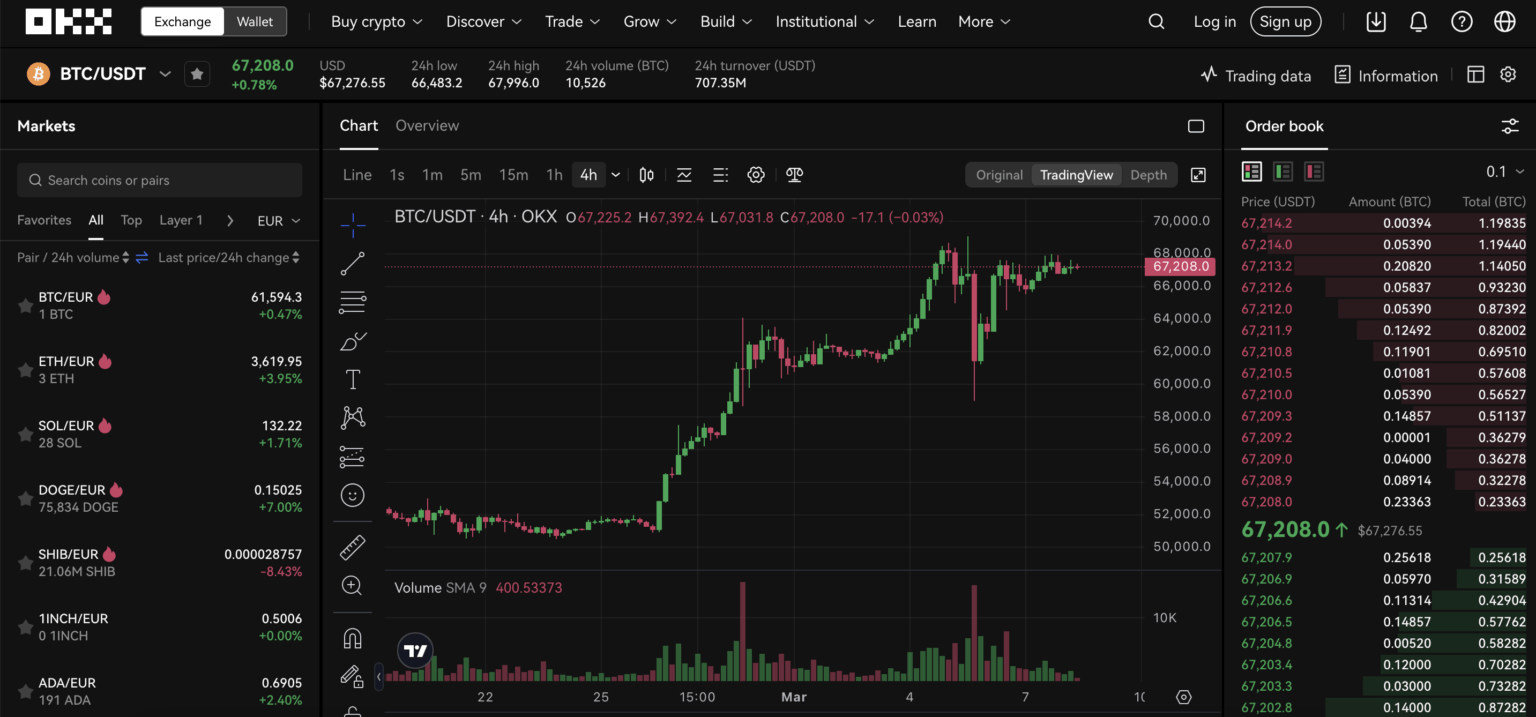
How OKX spot trading works — the mechanism that matters
Spot trading is the simplest priced mechanism on an exchange: you buy or sell an asset at the current market price and receive custody immediately on the platform (subject to withdrawal processes). OKX’s spot market benefits from deep order books for majors like BTC and ETH, TradingView-based charting, and cross-platform access (web, mobile, extension). Mechanically, when you submit a market order you accept the best available liquidity; when you post a limit order you may improve price but wait for fill. That basic choice—immediacy versus price control—is what most mistakes reduce to.
Key operational points for US traders: slippage and liquidity are asset-specific. OKX supports over 300 cryptocurrencies, but recent housekeeping such as the 2026-03-12 delisting of RSS3, MemeFi, GHST, RIO, and SWEAT pairs is a reminder: low-volume markets are periodically pruned. Delisting is not a failure so much as a liquidity-management mechanism; it reduces the risk of stuck orders and extreme spreads but can mean you must withdraw or convert holdings before support is removed. So always check pair status before entering illiquid positions and be prepared with an exit plan for listings that might be removed.
Spot vs margin vs derivatives: matching instrument to intent
OKX offers spot, margin (up to 10x), and a derivatives suite (perpetuals, quarterly futures, options with up to 125x leverage on some assets). The mechanism and incentives differ greatly across these products. Spot exposure is straightforward price exposure and is compatible with both custody-on-exchange and off-exchange strategies. Margin borrows against your balance to amplify returns and risks; cross-margin shares collateral across positions whereas isolated margin confines risk to a single trade. Perpetuals introduce funding-rate mechanics that can push or pull price convergence; options add non-linear payoffs and time decay.
Trade-off framework: pick the simplest instrument that accomplishes your objective. If you want long-term exposure to an asset’s fundamentals, spot is cleaner and avoids liquidation risk. If you seek short-term directional leverage and can monitor risk closely, margin or perpetuals may be efficient — but they demand discipline, maintenance margins, and an awareness that extreme moves can produce rapid slippage and forced liquidation, especially in thinly traded contracts.
OKX wallet: when to self-custody, when to use the exchange
OKX’s platform mixes custodial and non-custodial models. The exchange stores >95% of assets in multi-signature cold wallets, and also offers a non-custodial Web3 wallet that gives users control of private keys and supports hardware devices like Ledger and Trezor. The mechanism difference is clear: custodial balances are convenient and covered by the exchange’s operational controls (and subject to PoR transparency), while a non-custodial wallet removes counterparty risk at the cost of user responsibility for seed phrases and local device security.
A practical heuristic: use custodial spot balances for active market-making or fast trading where immediate order placement and quick transfers matter; use the self-custodial wallet for long-term holds, DeFi interactions, and when you need to prove ownership outside the exchange. If you bridge between the two, treat transfers as a workflow with friction — gas, confirmations, and smart-contract risk — and always test with small amounts.
Security mechanisms and where they fall short
OKX deploys several institutional-grade protections: cold storage with multi-sig approvals, Proof of Reserves for on-chain backing transparency, military-grade encryption, and AI-driven login threat detection. At the account level it enforces KYC (ID plus liveness check) and mandatory Two-Factor Authentication (2FA) options including biometrics on mobile apps. These are effective defenses against systemic counterparty failure and some classes of remote attack.
But practical limits remain. Phishing remains a user-level epidemic: credential compromise or approving a malicious wallet signature still defeats platform protections. Self-custodial wallets introduce permanent-loss scenarios if seeds are mismanaged. And DeFi interactions routed through OKX’s DEX aggregator bring smart-contract risk that is orthogonal to exchange custody. In short: technical custody controls reduce certain institutional risks but do not eliminate user operational risk. The right tactics are layered: hardware wallets, unique passwords, phishing-resistant login habits, and minimal on-exchange balances aligned with your trading horizon.
Comparisons and trade-offs: OKX vs two common alternatives
Compare OKX to a narrowly focused CEX and to a pure DeFi workflow. Versus a narrow CEX, OKX’s advantage is breadth: derivatives, staking, NFTs, and a Web3 wallet in one interface reduce frictions for traders shifting roles (e.g., spot trader who farms yield on idle assets). The trade-off is surface complexity and a larger attack surface: more services mean more interactions to secure and more policies to understand.
Compared with pure DeFi (wallet-to-wallet AMMs, lending protocols), OKX centralizes custody and compliance, which simplifies fiat rails and offers institutional-style controls (cold storage, PoR). The trade-off is counterparty dependence and KYC; if your priority is censorship resistance and privacy, pure DeFi may be preferable despite higher smart-contract risk and less predictable on-ramps for USD trading.
Decision-useful heuristics for logging in and trading on OKX
Heuristic 1: Minimum on-exchange balance — keep only what you need for active trading and overnight margin, move the rest to a hardware-backed self-custodial wallet. Heuristic 2: Match instrument complexity to monitoring capacity — avoid high-leverage derivatives unless you can monitor intraday and accept the liquidation mechanics. Heuristic 3: Flow test before large transfers — use small test amounts when moving between wallet and exchange or using cross-chain bridges, especially because OKX’s DEX aggregator can route across chains and contracts with varying reliability.
If you want a straightforward entry point to your OKX account and tools that help with these practices, start at the platform login page and review security settings immediately after you sign in to enable 2FA and review withdrawal whitelist options. For convenience, see the official login guidance here: okx.
What to watch next (conditional signals, not predictions)
Watch three signals that will matter for traders in the US: regulatory guidance related to derivatives and stablecoins (affects margin and futures availability), patterns of delisting low-volume pairs (affects liquidity for niche tokens), and the evolution of cross-chain bridge security (affects using the DEX aggregator and moving assets between chains). If exchanges continue pruning low-volume pairs, expect liquidity concentration in majors and an efficiency premium for markets that remain listed. If cross-chain exploits increase, expect more conservative bridge limits and higher on-chain fees during stress.
FAQ
Is it safe to keep all my crypto on OKX?
“Safe” depends on what risks you accept. OKX uses cold storage, multi-sig withdrawals, and PoR transparency — all strong institutional controls — but any custodial model requires trust in the operator and exposes you to platform-level operational and regulatory risk. If you prioritize counterparty-free ownership, use the non-custodial OKX wallet with hardware keys; if you prioritize convenience and rapid trading, custodial balances are pragmatic but should be minimized to amounts you actively use.
How does spot trading on OKX differ from using the DEX aggregator?
Spot trading on OKX occurs on its centralized order books with order matching and typically deeper liquidity for majors. The DEX aggregator sources liquidity across decentralized exchanges and can find optimal swap routes or cross-chain transfers, but it exposes you to smart-contract risk, gas fees, and slippage that vary with on-chain conditions. Use spot for price certainty and low spreads in liquid markets; use the DEX aggregator for tokens not listed centrally or for on-chain composability.
What should US traders know about KYC and withdrawals?
OKX requires Know Your Customer (KYC) verification — government ID and a facial liveness check — to comply with AML rules. KYC affects withdrawal limits, fiat access, and some product eligibility. Plan KYC early if you intend to move large sums or use derivatives that may have regulatory constraints in US jurisdictions.
Can I use hardware wallets with OKX?
Yes. OKX’s non-custodial wallet supports hardware integrations like Ledger and Trezor. This is a strong defense against remote compromise when interacting with DeFi and managing long-term holdings; remember to keep recovery phrases offline and never approve signatures from untrusted dApps.
Final, practical takeaway: treat OKX as a multifunction toolkit rather than a single product. That toolbox lowers some frictions and raises others; your job as a trader is to map each tool to a clear objective, choose the instrument with the smallest number of unnecessary failure modes, and operationalize simple safeguards — hardware keys, minimal on-exchange balances, and routine checks on pair listings and bridge status. Those habits turn platform capabilities into reliable outcomes.